https://editionsgrandier.bandcamp.com/album/john-bull-organ-works-of-the-early-period-2
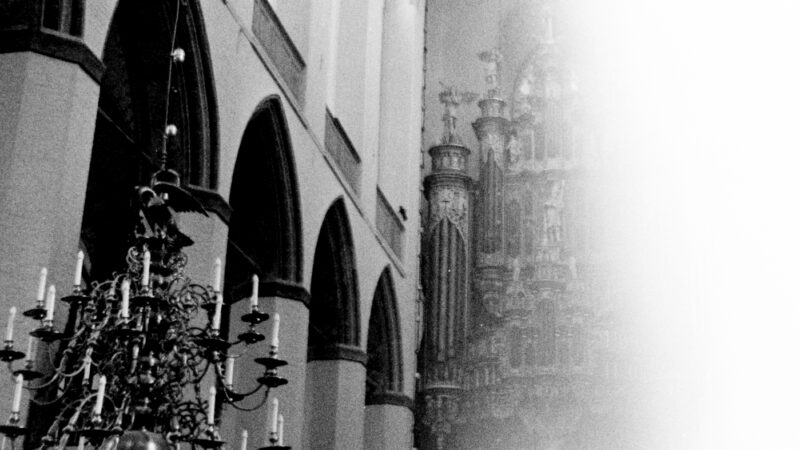
The first recording in the series on John Bulls music focuses on the first period of the composers output, while he was living in England. During this time he was organist to Elizabeth I, and was mostly required to improvise dance music for diverse events on the large consort organs, and direct the chapel choir. He was also involved in playing organ (improvisation?) in the theaters in London, which interestingly was in collaboration with the royal chapel choir and other instrumental consorts, specifically performing in the premiere of Christopher Marlows, Doctor Faustus. During this time he was using the consort organs, small portable instruments that have narrow scaled pipes imitating the viol de gambas, also sometimes combined with a virginal or harpsichord. Bull creative phase in this time is focused on luxurious and thick voicing, and also as well interest in obscure time signatures and modes. This project was fortunate enough to be recorded on a very special instrument in Oosthuizen, being original from the gothic period of around 1470, then plausibly reassembled by a 17th century builder Pieter Backer and placed in the church. The late gothic pipework is presumed to be made by Pieter Gerritz, who built the large organ in the St. Bavo in Haarlem.
https://editionsgrandier.bandcamp.com/album/heinrich-scheidemann-mascarada-2
The music of Heinrich Scheidemann produces us with much inspiration. We can say that Scheidemann appears to be a ‘Chopin of the organ’, in the sense that Scheidemann uses the organ in the same way that Chopin used the piano, focusing on acoustics and long melodic/melismatic/ligature material. Focusing on a sense of musical poetry, Scheidemann’s oeuvre is vast, also consisting of 3 major stylistic shifts in his process. Most of the pieces in this album are from the middle period, at the very height of the 30 years war from the 1620-1630’s. As is customary with, 17th century organ composers, they write each piece in one day in a very short amount of time, as one piece was dated in February, another in march of another year etc, giving us a clue about the ephemeral nature of these pieces. Scheidemann’s harmonic language is closely linked to the English tastes of the time, in particular through the school of madrigalists headed by Thomas Morley, the sworn rival of Bull. He rejects the musical style of his teacher Jan Pieterzoon Sweelinck (while retaining technical aspects) and focuses on a dramatic structure underneath the pieces. We have a very good set of sources on how Scheidemann sounded when he played his own music. Kortkamph describes a ‘Lieblichkeit’ in the style of treating the organ, and also documented is Scheidemann’s specific fingering system or “applicatio” (he had very large hands) and ornamentation preferences. The ornamentation system is quite similar to Sweelincks, linking the Lynar source to the Campheusyn Manuscript. One can imagine a performing style slightly relating to Bulls famous playing, but more friendly, and more elements of legato and ease of rhythmical structures. Interestingly in May of 1622 from Hamburg, Bull writes an arrangement of a Madrigal, but only using Scheidemann’s diminution signatures. Maybe there was a connection of these two musicians?
https://editionsgrandier.bandcamp.com/album/mannerism-organ-music-from-1550-1650
After being invited to visit this small instrument in Sassenheim, a recording project was made of a varied program, consisting of music from 1550-1650. The instrument is a very beautiful Goltfuz organ, who also worked in Flanders in Leuven, and the instrument was originally designed for a much larger space, hence the loud mixtures. In particular the 4’ octav has a lyrical quality. This varied program consist of different forms and contexts of organ music from this time, from rhetorical Toccatas to the pure canonical structures.
https://editionsgrandier.bandcamp.com/album/john-bull-organ-works-1613-1628-2
The 2nd recording in the series recording the works of John Bull is dedicated to the composers output during his time in the Spanish Netherlands. During this late creative period, his style shifted drastically, favoring unbalanced voicing structures, canonical obsession, and a darker and dramatic atmosphere. His political situation also impeded on his creative actives, as for an unknown reason he had to flee England in 1613? Seeking first employment in the Brussels court chapel for four years then permanently in the Cathedral of Antwerp, with its remarkable instrument from Brebos in 1562. The great number of pieces are derived from the manuscript source Mus.Hs. 17771 held in the Vienna state library. Regarded to be in Bulls own hand, this manuscript consolidates his compositions around the period of 1621. Historic registrations are in particular derived from the set by Wilhelm van Lare, who in collaboration with Bulls fellow colleague Peter Phillips, wrote down a set of registrations for the organ in the St. Jacob’s in Antwerp around the same time. Also the historic registrations from the Brebos organs in El Escurial (1599) were used in their potential connection to Bull. Whether this could be Bull’s registration perspective one cannot prove, and knowing Bull’s defiant character in the music, it could very well be the opposite.
https://editionsgrandier.bandcamp.com/album/samuel-scheidt-tabulatura-nova-1624
In March 2025, Michael Bennett teamed up with audio engineers Bram van Klink and Victor Marbus to record a selection of emblematic pieces from Samuel Scheidt’s magnum opus “Tabulatura Nova”, published in 1624. This music from 1624 imbeds itself as part of our Zeitgeist now more than ever before, it forms a Musical prophecy. Mysterious energies emanate from the music and character of Samuel Scheidt, and contrasting with the music of the time, his process at the organ originates from focusing inward on the sound material itself, opposed to rhetorical figures. Central to the project is the organ of the Waalse Kerk in Leiden, tuned in 1/4 meantone, whose tonal disposition and sound bear a remarkable affinity to the now non-existent Moritzkirche organ in Halle (Compenius 1625) associated with Scheidt’s circle. The 1/4 Comma Meantone organ at the Waalse Kerk Leiden provides the historically accurate Klangfarben for Samuel Scheidt’s music, as it is focused on the late mannerist sound world of the organs constructed from 1580-1618, although constructed in the middle of the 18th century. Using the Historical Registrations from Samuel Scheidt himself as well as specifically reconstructed playing techniques from the early 17th century, including composer-specific ornamentation and temporal manipulation described in the historical sources, we are able to hear the music as Scheidt Intended; confrontational, mysterious, and deeply emotional. As a creative counterbalance, Michael Bennett presents original improvisations in his style utilising the playing techniques of Samuel Scheidt along with his original harmonic language.